
Menu
- Home
- Ask an Expert
- Your EFAP
- Wellness resources
- Wellness in the workplace
close
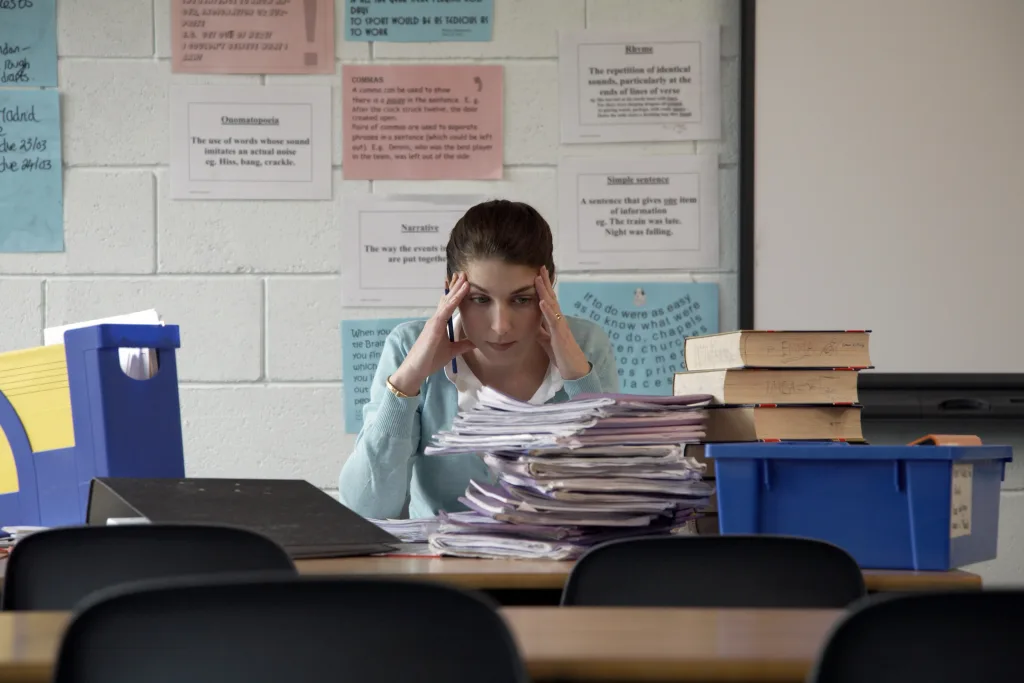
As a new school year begins, many educators are already running on empty. Burnout among Alberta teachers and education workers is common, and workload and working conditions play a much bigger role than character or willpower. Nationally, education is consistently named among the sectors most affected by burnout in Canada. If any of this feels familiar, you are not alone, and there is a lot that can genuinely help.
Sam has been teaching for six years in an inner-city neighborhood and takes real pride in the work. She cares deeply about her students’ success and takes initiative to be an outstanding educator.
Over the past few years, she has pushed herself hard to make a difference. But it has come at a price.
The joy Sam once found in her work has started to diminish. She works through lunch and often stays late to keep up with board requirements. Hearing difficult stories about student well-being sometimes follows her home after the day ends. She is not sleeping well and finds it harder to focus. She has started skipping softball games and turning down social invitations because she is exhausted. She has also noticed herself snapping over small things, including with students she genuinely cares about.
The work Sam once cared so much about now feels overwhelming, and she wonders if she is making a difference at all.
Sam feels like a failure. But she is not. She is experiencing depletion from caring and coping with too much, for too long, without enough opportunities to recover.
If any part of her story sounds familiar, you are not alone. Many educators will recognize themselves somewhere in it at some point during the school year.
The data reflects this reality. A recent study of teachers across three provinces including Alberta found that more than three in four reported symptoms of emotional exhaustion, with workload identified as the leading contributing factor. Nationally, the Mental Health Research Canada has identified education among the professions most affected by burnout, with roughly one in three working-age Canadians experiencing burnout at some point.
Depletion and burnout can feel incredibly disempowering. Educators sometimes feel trapped within systems and conditions that make meaningful progress difficult.
But hope exists, and recovery is within reach.
Burnout is not a personal failure.
The World Health Organization defines burnout as a syndrome resulting from chronic workplace stress that has not been successfully managed. It is marked by three things:
Burnout can affect anyone. However, people working in education, health care, caregiving, and other high-exposure professions are often at greater risk.
Our well-being typically moves along a continuum rather than at a fixed point. Understanding that continuum can help you recognize where you are today and what kind of support may help.
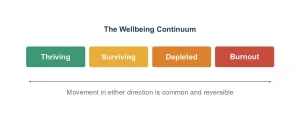
Thriving
Coping well and feeling energized
Surviving
Managing, but with a smaller reserve
Depleted
Low on energy and easily overwhelmed
Burnout
Persistent exhaustion, emotional distress, and detachment
This continuum is not a substitute for professional advice. Most people move back and forth across different parts of it throughout their lives, and the experience looks a little different depending on individual circumstances.
Perhaps you have been under pressure at work while also juggling caregiving or personal responsibilities. You may notice yourself moving from thriving to surviving. If that stress continues without opportunities to recover, signs of depletion can start to emerge.
The important thing to remember is that movement on the continuum goes both ways. Small opportunities to recharge, along with the right supports, can help you regain energy and move toward thriving again.
Resilience is not about pushing harder or enduring more. It is shaped by many factors, including the conditions we live and work in, the supports available to us, and the coping skills we can draw on. In practice, resilience is about recognizing how you are coping today and taking steps, however small, to support your well-being.
Burnout recovery rarely comes from one dramatic lifestyle change.
Sam did not fix everything at once, and she did not need a complicated plan. Instead, she worked with professionals through her Employee and Family Assistance Program (EFAP) and adopted a handful of small, consistent practices that helped her regain energy over time and gradually return to thriving.
None of these strategies were about pushing on, even when things were hard. Instead, they helped build her capacity to recover so that even a demanding school year felt more sustainable.
When stress is high during the day, the goal is not to eliminate it. The goal is to create a small pause before moving into whatever comes next.
Try a quick reset
Protect your energy with boundaries
Boundaries are not about caring less. They make it possible to keep caring sustainably.A few concrete ways to communicate boundaries include:
The pause, when you feel pressured or tend to people-please:
Give yourself time; even a few minutes to make a better decision. Saying something like, “Let me check and get back to you later today,” gives your brain a chance to reset and make an informed decision.
The clear limit, when you already know your capacity:
Something as simple as, “I do not have capacity to do this right now,” may suffice.
The redirect, especially useful with students and parents:
“I know this is important. Here’s what I can provide right now…”
Boundaries apply to emotional demands as well. You can hold space for a student or colleague’s struggle in the moment, without carrying their struggles home as your own.
Telling urgent from important
Firefighting or constantly reacting to whatever feels most urgent, can continue to push meaningful things (the ones with no looming deadline) aside.
A simple decision framework can help:
For Sam, one of the biggest shifts was not at school, it was improving the transition between work and home.
Without a deliberate reset, the nervous system often remains in “work mode” long after the workday ends. Stress can follow you home even when you are no longer at school.
Create a downshift routine
Sam’s routine included:
Even three to five minutes of intentional decompression can reduce how much of the day spills into the evening and affect sleep.
Shift your story
Under stress, thinking tends to get more rigid and self-critical. Often without noticing, our thoughts can weigh us down and deplete our energy. Think about the repeated impact of a thought like, “I completely suck at this job!”
Some common negative thought patterns include:
A helpful cognitive-behavioural approach you could try, is a three-step notice, explore, choose process:
For example, “I completely suck at this job” might become “I am doing my best under hard conditions.” That is not toxic positivity, just a more accurate and workable read on the situation.
Practice self-compassion
This is one of the most well-supported tools for staying steady under pressure, and it has three parts, based on the work of author and researcher Kristin Neff:
Stay connected, and ask for help
Human beings do not do well carrying things alone.
In caring professions, there can be an unspoken expectation to simply keep going. Yet, bottling up emotions is consistently linked to increased burnout over time.
Some ways to counter that include:
Focus on small, consistent self-care
None of this needs to be a complete lifestyle transformation.
Small, repeatable habits across a few areas tend to matter more than any single big change. This might look like:
None of these simple changes erased Sam’s workload and the pressure to show up for her students each day. Together, however, they gave her greater capacity to manage it and recognize when she needed additional support.
Self-care includes recognizing when you need more than personal practices can offer.
Consider reaching out to a healthcare provider, counsellor, or your EFAP if:
Reaching out is not a last resort, it is simply the next reasonable step.
Your EFAP is included in your ASEBP benefits at no cost to you and is available through GreenShield.
Whether you are looking for counselling, coaching, or practical support, EFAP provides confidential services for both covered members and their dependants. Each year, you have access to:
Your available hours reset every January 1.
EFAP can be a valuable first step in accessing mental health support. Depending on your needs, however, the program’s counselling hours may be used quickly. If you think you may need ongoing support, consider connecting with your primary health care provider early to discuss longer-term treatment options and referrals. Wait times for some mental health services can be significant, so it may be helpful to begin exploring these supports as soon as possible.
In addition to EFAP, your ASEBP benefits include coverage for psychological and counselling services. Each calendar year, you and your eligible dependants have a combined maximum of $1,200 per person for psychological and counselling services, including assessments. This coverage can help support ongoing treatment for mental health concerns when additional care is needed beyond what your EFAP covers.
To access the program and book appointments, you and your dependants must first register with GreenShield. Visit GreenShield+ to create an account and explore the services available to you.
The information provided through the Ask an Expert Hub is for personal use, reference, and education only. It is not intended to provide personalized medical, mental health, legal, financial, or other professional advice. Members should consult an appropriate health care provider, pharmacist, financial professional, legal advisor, or qualified professional before making decisions related to their individual circumstances.
With over 20 years’ experience as a mental health educator, facilitator, and coach, Sue-Ann is passionate about workplace mental health. She has partnered with leading Canadian employers and business leaders, designing solutions to enhance leadership skills and mental health outcomes. Sue-Ann has been instrumental in the research and development of several award-winning initiatives, including the Leadership and Mental Health Certificate™ Program in collaboration with Queen’s University. In 2014, Sue-Ann was awarded a ‘Special Citation’ by the International Association of Firefighters for her role advancing mental health education within the Mississauga Fire and Emergency Service. She obtained her master’s degree in counselling psychology and Adult Education from the University of Toronto. She is an instructor for Mental Health First Aid and an accredited leadership coach through the International Coaching Federation (ICF).
For more information, email benefits@asebp.ca or call 1-877-431-4786
You can also schedule a phone or video meeting with a benefit specialist at asebp.ca/contact-us